
What happens when sales stay relatively quiet, but the number of homes available for sale starts dropping faster?
That is the part of the August market I’m paying attention to.
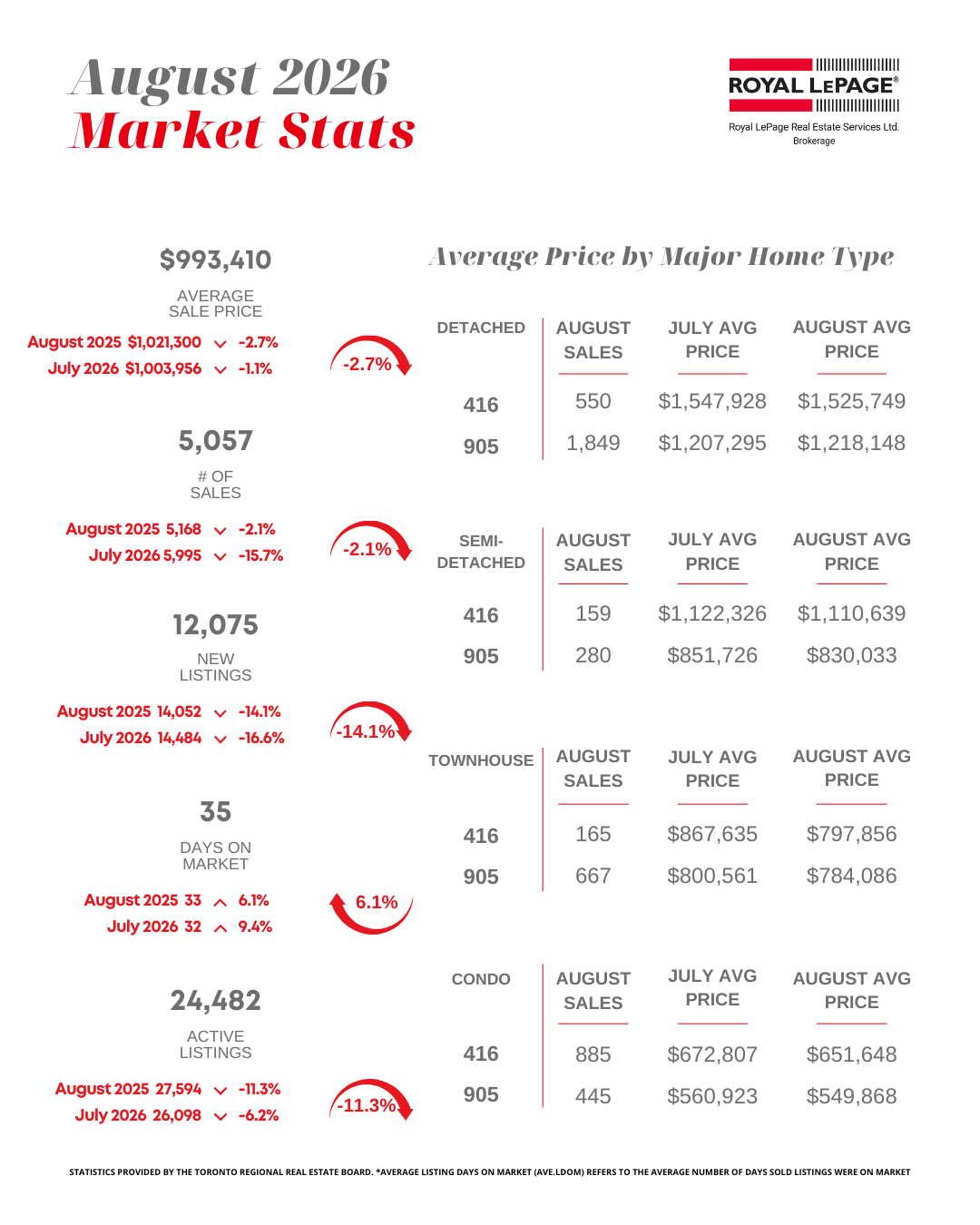
The GTA recorded 5,057 home sales in August, down 2.1% from August 2025. On its own, that sounds like more of the same: a slower market with buyers taking their time.
But new listings fell much more sharply — down 14.1% year over year to 12,075 — while active inventory declined 11.3%.
That changes the picture.
We are not suddenly back in a highly competitive market. Buyers are still selective, properties still need to be priced properly, and conditions vary considerably by neighbourhood and property type.
But there is now less available inventory for those buyers to choose from.
And that is worth watching as we move into the fall.
Prices are still below last year — but the monthly numbers are stabilizing
The GTA average selling price in August was $993,410, down 2.7% from a year earlier.
The MLS® Home Price Index Composite benchmark was also lower year over year.
Month to month, however, the picture was steadier. The benchmark was essentially flat compared with July, while the seasonally adjusted average selling price edged higher.
One month does not establish a new price trend.
What it does tell us is that the market is no longer simply about rising inventory and falling prices. Supply is beginning to tighten, while prices are showing some signs of stabilization.
That is a different market than we had earlier in the cycle.
What does this mean if you are buying?
There is still opportunity for buyers.
Prices remain below last year's levels, and this is not a market where every property automatically attracts multiple offers. Depending on the home, neighbourhood and competition, buyers may still have room to negotiate price, conditions and closing terms.
But I would not confuse that with unlimited choice.
If inventory continues to decline, the strongest properties — well located, properly priced and in good condition — can start attracting several serious buyers even while the broader GTA statistics continue to look relatively soft.
That distinction matters.
A buyer looking at a condo with several comparable units available may have considerable negotiating leverage.
A buyer waiting for the right detached house on a particular street in Bloor West Village, High Park, The Kingsway or another tightly held neighbourhood may have a very different experience.
The GTA average does not tell you how much competition exists for the specific property you want.
If you are planning to buy, I would want three things clear before the right listing appears:
Your financing, including what you can comfortably carry rather than simply the maximum you can qualify for.
Your neighbourhood and property priorities, so you know which compromises you will make and which ones you will not.
Your numbers, so you can recognize value without having to make the decision from scratch when a strong property comes to market.
Being prepared does not mean rushing.
It means being able to act when the numbers and the property make sense.
What does August mean if you are selling?
For sellers, declining inventory is constructive — but it does not remove the need for a disciplined pricing strategy.
There are fewer competing listings than there were a year ago, which can help a good property stand out.
But buyers have spent the last several years becoming much more price-sensitive. They are comparing recent sales carefully, looking at how long properties have been listed, and deciding quickly when an asking price does not match the market.
That creates a fairly clear divide.
Strong property + realistic price + good presentation can create competition.
An ambitious price based on what a neighbour received in another market can still leave a property sitting.
If you are considering selling this fall, the important question is not simply, “Is the market getting better?”
It is:
How much competition would my particular property have if we listed it now — from both other sellers and active buyers?
That requires looking at your immediate market, not the GTA headline.
Detached homes remained relatively resilient
Detached homes accounted for 2,399 sales in August, with an average GTA selling price of $1,288,669.
Townhouses recorded 832 sales, averaging $786,817, while condominium apartments recorded 1,330 sales at an average price of $617,593.
The differences between these segments matter.
Detached housing has been relatively resilient, while the condo market continues to offer buyers considerably more choice in many parts of the GTA.
For someone moving from a condo into a house, for example, the relevant number is not simply whether “Toronto prices” are up or down.
It is the price gap between what you are selling and what you are buying.
That gap can create an opportunity even when neither side of the transaction feels perfect on its own.
The fall market may tell us more
August does not give us enough evidence to call a significant market turn.
It does give us a signal.
Listings are declining faster than sales.
If that continues while buyer activity holds or improves, negotiating conditions can tighten and prices may eventually respond.
The opposite is also possible: improving conditions for sellers may encourage more homeowners to list, rebuilding inventory and giving buyers more choice again.
That is why I would be careful about making a real estate decision based on a prediction that prices are either about to take off or about to fall substantially.
The better question is much more practical:
What are you trying to do over the next few years, and does the market available to you today give you a reasonable way to do it?
For a buyer, that means looking at your financing, time horizon and the specific properties available to you.
For a seller, it means understanding current value, competition, your likely net proceeds and what happens after the sale.
And if you are selling and buying, the two decisions need to be looked at together.
That is where market statistics become useful — when they are connected to an actual decision.
If a move is on your mind and you want to understand what the August numbers mean for your property, neighbourhood or next purchase, book a Clarity Call.
We’ll look at your numbers, timing and options together.
Luba Beléy
Broker
Royal LePage Real Estate Services Ltd., Brokerage
Toronto West End & South Etobicoke
Real Estate Broker since 2008
This article is general market information and is not intended as legal, financial, mortgage or individual real estate advice. Market conditions vary by property type and location.
Source: Toronto Regional Real Estate Board (TRREB), August 2026 Market Watch.